
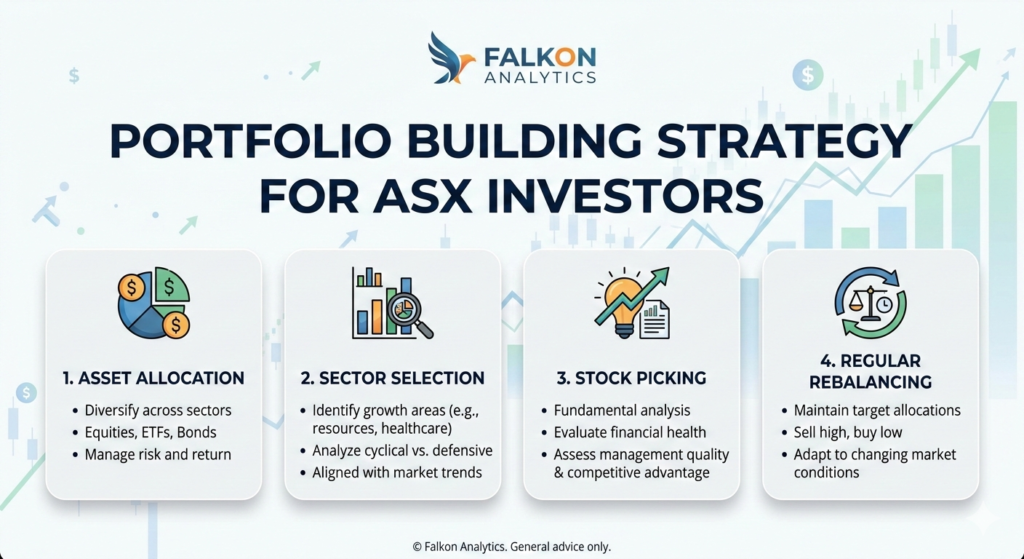
Portfolio Building Strategy for ASX Investors: A Structured Approach to Long-Term Wealth Creation
Building a portfolio is not about randomly buying shares. It is about constructing a risk-managed system designed to grow capital over time while protecting against unnecessary volatility.
In the Australian Securities Exchange (ASX), where sectors like banking, mining, healthcare, and energy dominate index weightings, portfolio construction becomes even more important. Without structure, investors often become overly exposed to one sector — especially financials or resources.
This guide explains how ASX investors can build a disciplined, diversified, and resilient portfolio.
Why Portfolio Structure Matters More Than Stock Selection
Many investors focus entirely on “finding the next big stock.”
However, long-term returns are often determined more by:
- Asset allocation
- Risk control
- Diversification
- Position sizing
- Behavioural discipline
A great stock inside a poorly structured portfolio can still lead to poor outcomes.
Portfolio building is about designing a system — not chasing returns.
Step 1: Define Your Investment Objective
Before building a portfolio, clarify:
- Are you investing for retirement?
- Are you building dividend income?
- Are you targeting capital growth?
- What is your time horizon?
- What level of volatility can you tolerate?
For example:
Long-term growth investors (10+ years)
→ Can tolerate higher volatility
→ May allocate more toward growth stocks
Income-focused investors
→ May prioritise dividend-paying ASX companies
→ Focus on capital preservation
Clarity drives allocation decisions.
Step 2: Decide Your Asset Allocation
Asset allocation is the foundation of portfolio construction.
It determines how your capital is distributed across asset types.
For ASX investors, allocation typically includes:
- Australian equities
- International equities (via ETFs)
- Cash
- Fixed income
- REITs or infrastructure
A sample structure (illustrative, not advice):
- 60–70% Equities
- 10–20% International exposure
- 10–20% Cash or defensive assets
Asset allocation reduces concentration risk in one market.
Step 3: Diversification Within the ASX
The ASX index is heavily weighted toward:
- Financials
- Materials (mining)
Without diversification, portfolios become sector-heavy unintentionally.
A balanced ASX portfolio may include:
1️⃣ Financial Sector
Banks and financial institutions often provide dividend stability.
2️⃣ Materials & Mining
Cyclical exposure linked to global commodity cycles.
3️⃣ Healthcare
Defensive growth and global exposure.
4️⃣ Consumer Staples
Stable earnings during economic downturns.
5️⃣ Technology
Higher growth, higher volatility.
6️⃣ Energy
Commodity-linked but different drivers than mining.
Diversifying across sectors reduces correlation risk.
Step 4: Core-Satellite Strategy (Effective for ASX Investors)
A practical approach for many investors is the Core-Satellite model.
Core Portfolio (60–80%)
Stable, long-term holdings such as:
- ASX 200 ETF
- Blue-chip dividend stocks
- High-quality large caps
Purpose:
- Provide steady growth
- Reduce volatility
- Form portfolio foundation
Satellite Portfolio (20–40%)
Higher-growth or higher-risk positions:
- Mid-cap growth stocks
- Thematic opportunities
- Emerging sector plays
Purpose:
- Enhance returns
- Capture growth potential
The core protects. The satellite accelerates.
Step 5: Position Sizing Discipline
Position sizing is one of the most underrated elements in portfolio management.
Avoid:
- Allocating 40–50% into a single stock
- Concentrating in one theme
General principles:
- 5–10% per core position
- Smaller allocations (2–5%) for higher-risk satellite stocks
Position size should reflect:
- Risk level
- Business stability
- Earnings predictability
Risk management starts with allocation.
Step 6: Dividend vs Growth Balance
The ASX is known for dividend-paying companies.
However, focusing only on dividend yield can reduce long-term growth.
A balanced portfolio may include:
- Dividend-generating stocks for income
- Growth stocks for capital appreciation
- ETFs for diversification
Chasing high yield without examining sustainability can increase risk.
Always assess payout ratios and cash flow stability.
Step 7: Risk Management Framework
Risk is unavoidable — but controllable.
Key risk management principles:
- Diversify across sectors
- Avoid overexposure to cyclical industries
- Maintain some liquidity (cash buffer)
- Avoid emotional decision-making
- Rebalance periodically
Rebalancing forces discipline — trimming overweight positions and reinvesting in underweight sectors.
Step 8: Managing Market Cycles in the ASX
The ASX is influenced by:
- Commodity price cycles
- Interest rate movements
- Chinese demand trends
- Global economic shifts
During commodity booms:
Mining stocks outperform.
During defensive cycles:
Healthcare and staples often outperform.
Portfolio construction should recognise cyclical rotation.
Avoid overconcentration at cycle peaks.
Step 9: Rebalancing Strategy
Over time, some stocks will outperform others.
Rebalancing ensures:
- No position becomes too dominant
- Risk profile remains aligned with goals
- Profit-taking occurs systematically
Typical rebalancing frequency:
- Annually
- Or when allocation deviates significantly
Rebalancing enforces discipline.
Step 10: Behavioural Discipline
Many portfolios fail not because of structure — but because of emotion.
Common behavioural mistakes:
- Panic selling during corrections
- Overconfidence during bull markets
- Chasing hot sectors
- Ignoring valuation
A structured portfolio reduces emotional reactions.
Rules should guide decisions — not market noise.
Portfolio Example Framework (Illustrative Structure)
Example diversified ASX-focused portfolio:
Core:
- Broad ASX ETF
- Two major banks
- One healthcare leader
Satellite:
- One growth mid-cap
- One emerging sector exposure
- One thematic ETF
Plus:
- Cash allocation for flexibility
This structure balances stability and opportunity.
Long-Term Compounding: The Real Goal
Portfolio building is not about monthly performance.
It is about:
- 5-year discipline
- 10-year patience
- Compounding returns
Consistent structure + risk management + time
= Sustainable wealth building
Short-term volatility is normal.
Structural discipline is rare.
Common Portfolio Building Mistakes
- Overconcentration in one sector
- Ignoring global diversification
- Chasing short-term performance
- Focusing only on dividend yield
- Failing to rebalance
- Lack of defined risk tolerance
Avoiding these mistakes improves long-term outcomes more than stock picking alone.
Final Thoughts: Build a System, Not a Collection of Stocks
Successful ASX investing requires:
- Clear objectives
- Strategic asset allocation
- Diversification
- Position sizing discipline
- Emotional control
Portfolio building is a process — not a one-time decision.
At Falkon Analytics, we approach ASX portfolio construction through structured allocation, valuation awareness, and disciplined risk management — focusing on probability, not prediction.