
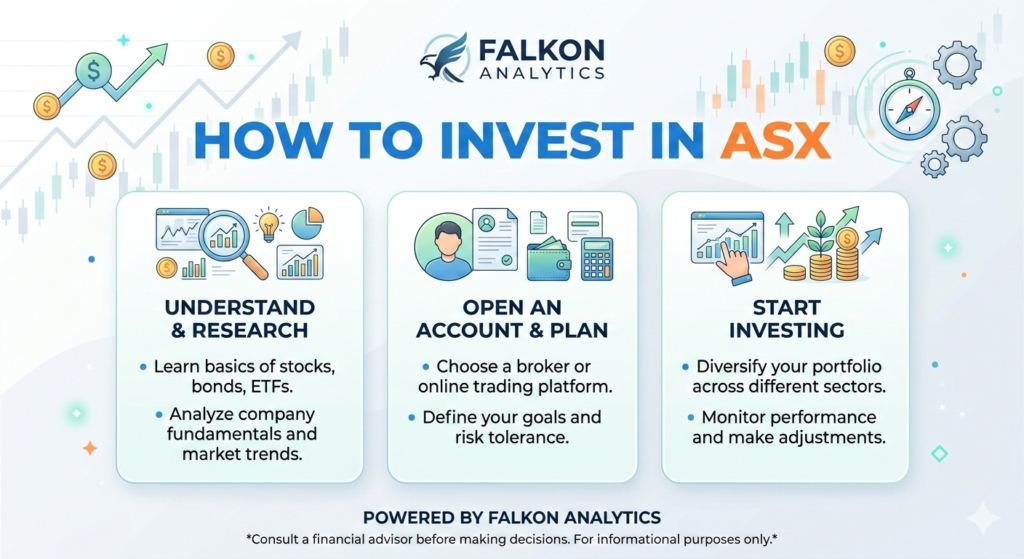
Investing in the Australian Securities Exchange (ASX) is one of the most practical ways to build long-term wealth in Australia. Whether your goal is financial independence, dividend income, or capital growth, understanding how to invest in ASX shares properly is critical.
This guide explains step-by-step how beginners can start investing in the ASX, what to look for before buying shares, and how to manage risk responsibly.
What is the ASX and Why Should You Invest?
The ASX (Australian Securities Exchange) is Australia’s primary stock exchange, where over 2,000 companies are publicly listed. When you invest in ASX-listed shares, you’re buying partial ownership in a company.
The ASX includes:
- Blue-chip companies (e.g., major banks and mining companies)
- Growth stocks
- Small-cap and micro-cap stocks
- Exchange Traded Funds (ETFs)
- REITs (Real Estate Investment Trusts)
Many investors choose the ASX because:
- It operates under strong regulatory oversight
- It offers dividend-focused investment opportunities
- It provides exposure to globally operating companies
- It allows easy access through online brokerage platforms
Step-by-Step Guide: How to Invest in ASX
Step 1: Define Your Investment Goals
Before investing, ask yourself:
- Are you investing for long-term growth?
- Do you want dividend income?
- Are you building retirement wealth?
- Are you looking for short-term trading opportunities?
Your goals will determine your strategy, risk tolerance, and stock selection approach.
For example:
- Long-term investors may prefer ETFs or blue-chip stocks.
- Income-focused investors may target high-dividend companies.
- Growth investors may look for undervalued expansion-stage companies.
Clarity reduces emotional decision-making.
Step 2: Open an ASX Brokerage Account
To invest in ASX shares, you need an Australian brokerage account.
Most brokers offer:
- Online trading platforms
- Mobile trading apps
- CHESS-sponsored ownership (important for direct share ownership)
- Research tools and reporting
When choosing a broker, consider:
- Brokerage fees
- Platform usability
- Research access
- Customer support
- CHESS sponsorship vs custodial structure
Always understand the fee structure before trading.
Step 3: Understand What You’re Buying
Many beginners make the mistake of buying shares based on tips or hype.
Instead, focus on:
- Company Fundamentals
- Revenue growth
- Profit margins
- Debt levels
- Cash flow
- Return on equity (ROE)
- Valuation
Even great companies can be bad investments if overvalued.
Key valuation metrics include:
- Price-to-Earnings (P/E) ratio
- Price-to-Book (P/B)
- EV/EBITDA
- Dividend yield
- Industry Position
- Is the company a market leader?
- Does it have competitive advantages?
- Is the industry growing or shrinking?
Smart investing is based on data, not speculation.
Step 4: Start With Diversification
One of the most important principles when investing in the ASX is diversification.
Avoid putting all your capital into one stock.
Diversification can include:
- Different sectors (banks, mining, healthcare, tech)
- ETFs tracking ASX 200
- Exposure to international markets through global ETFs
- A mix of growth and dividend stocks
Diversification reduces portfolio volatility and protects against unexpected company-specific risks.
Step 5: Decide How Much to Invest
Never invest money you may need in the short term.
A practical structure:
- Keep emergency savings separate.
- Invest surplus capital only.
- Use position sizing (avoid allocating more than 10–20% into a single stock unless highly experienced).
Risk management is more important than chasing returns.
Step 6: Place Your First Trade
Once you’ve researched a company:
- Log into your brokerage account.
- Enter the ASX ticker symbol.
Choose order type:
- Market order (buys at current market price)
- Limit order (buys at a set price)
- Confirm quantity and review brokerage fees.
- Execute the trade.
After purchase, monitor performance periodically — but avoid daily emotional reactions.
Long-Term Investing vs Short-Term Trading on ASX
There are two main approaches:
Long-Term Investing
- Focus on company fundamentals
- Hold for years
- Benefit from compounding
- Lower transaction costs
- Generally lower stress
Short-Term Trading
- Focus on price movements
- Requires technical analysis
- Higher risk
- Higher transaction costs
- Requires more active monitoring
For most beginners, long-term investing is statistically more sustainable.
Understanding Risks When Investing in ASX
All investments carry risk.
Major risks include:
- Market downturns
- Interest rate changes
- Inflation impact
- Company earnings decline
- Sector disruption
- Global economic shocks
Risk cannot be eliminated — only managed.
Practical risk management tools:
- Diversification
- Proper position sizing
- Avoid leverage early on
- Regular portfolio review
Common Mistakes New ASX Investors Make
- Following social media tips blindly
- Investing without understanding financial statements
- Overtrading
- Ignoring valuation
- Panic selling during volatility
- Concentrating capital in one stock
Avoiding these mistakes can dramatically improve long-term returns.
Should You Invest in Individual Shares or ETFs?
For beginners:
- ETFs provide instant diversification.
- Individual shares offer higher potential returns but require deeper research.
A balanced approach often works best:
- Core portfolio: ASX 200 ETF
- Satellite positions: carefully researched individual stocks
Final Thoughts: Investing in ASX Requires Discipline, Not Luck
The Australian stock market offers strong long-term opportunities — but successful investing requires:
- Research
- Patience
- Risk management
- Emotional control
- Data-driven decisions
Markets reward discipline over time.
At Falkon Analytics, we focus on structured ASX research, valuation clarity, and risk-aware insights to help investors move beyond speculation and invest with conviction.